


Developer solutions
Embedded payments
Read more
Agentic engineering is changing how software gets built. Learn how AI agents speed up payment integrations and what to look for in a payment provider.
Software development is going through its biggest shift in decades. Engineers who used to type every line of code can now direct AI agents to write, test, and revise it for them. That practice is called agentic engineering, and it’s changing not only how software gets built, but also how quickly a platform can add features.
For SaaS (software as a service) companies that want to add financial services to their platform, this raises a practical question: if an AI agent is going to handle your next payment integration, can your payment provider support that workflow? If not, you may face a longer, more complex integration than necessary.
To help you find the right partner, let’s look at how agentic engineering works, why it matters for embedded payments, and what separates providers who natively support it from those that don’t.
Agentic engineering is the practice of building software with the help of AI agents instead of writing every line of code by hand. A developer describes what they want — change this button, add this endpoint, connect this API — and an agent using a tool like Claude Code or Codex writes the code, runs the tests, and reports back.
The developer reviews the work, redirects where needed, and finalizes the code when everything’s right. The agent types, and the engineer reviews.
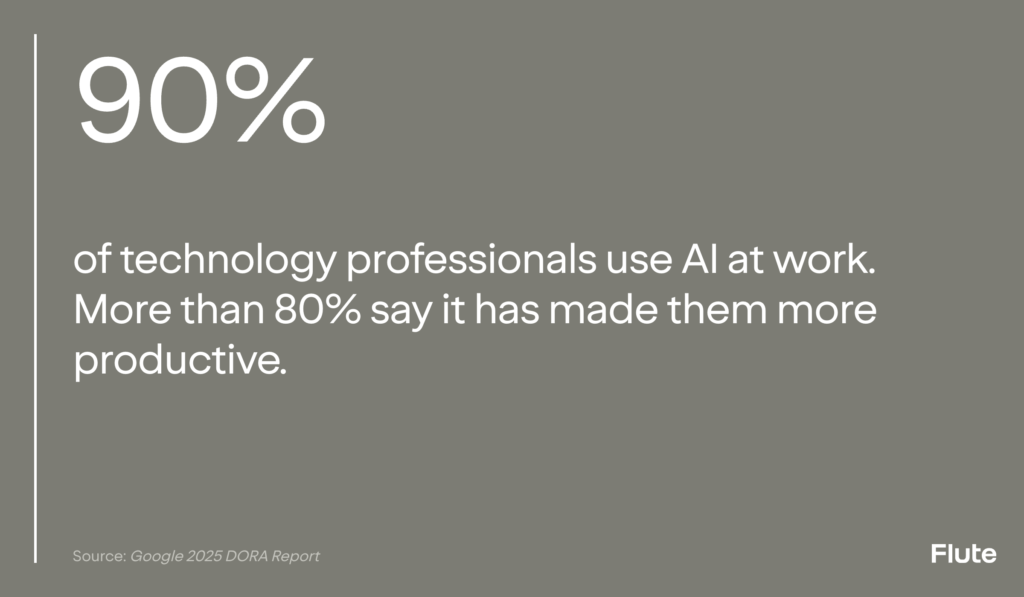
This isn’t a fringe workflow anymore. A recent developer survey found that 84% of developers use or plan to use AI tools in their development process, up from 76% the year before. Another report from Google found that 90% of technology professionals now use AI at work, and more than 80% say it has made them more productive.
None of this means engineers are obsolete. The same developer survey found that 46% of developers distrust the accuracy of AI output, which is exactly why experienced people still need to review, test, and approve what agents produce.
These two terms sound alike, but they sit on opposite sides of the transaction.
Agentic commerce is when AI agents shop and buy on a consumer’s behalf. This technology is still in the early stages; agents are already shopping for consumers, but most people still prefer to press “buy” themselves.
Agentic engineering is already seeing wide adoption and is actively reshaping how software gets built — and how quickly payment integrations are done.
For years, the decision to embed payments came down to one thing: does the upside justify the integration cost? That’s because, traditionally, the technical work required to add financial services like payments was a huge lift for software companies.
A payments integration could tie up a development team for months — reading documentation, mapping endpoints, handling edge cases, and testing against a sandbox. Not to mention other industry-specific requirements like becoming payment experts and meeting compliance. Salesforce reports that IT teams still spend 39% of their time building custom integrations, which is time most software companies would rather spend on their own product.
Agentic engineering eliminates that hassle.
When a payment provider publishes documentation an AI agent can follow, the agent can take the heavy lifting off the development team, meaning integrations that once took months of back-and-forth can run in a sandbox in minutes, with a production-ready build in days instead of months (or quarters).
The market isn’t waiting for SaaS platforms to catch up; embedded financial services are already becoming a baseline expectation, instead of a “nice to have.” Juniper Research projects that global embedded payment transaction value will reach $2.5 trillion by 2028, a 134% jump from $1.1 trillion in 2024. The broader embedded finance market is expected to reach $588 billion by 2030, growing at roughly 33% a year.
Platforms that can add payments quickly will capture that growth, while platforms stuck in six-month integration cycles will struggle to catch up.
Picture a CTO at a vertical software company — say, a platform built for funeral homes. Payments have been on the roadmap for two years, always one quarter away, always behind other features her customers are asking for. Adding financial options doesn’t seem like a big deal until her company starts losing customers to a competitor that promises users won’t have to juggle several providers for funeral home management and financial services; they’ll get everything in one place instead.
With an agent-ready provider, the CTO can copy a single integration prompt into her AI coding tool and hit start. By the time she’s out of her morning standup, the agent has connected her app to a sandbox and run a test transaction, and the project that never fit the roadmap suddenly fits inside a sprint.

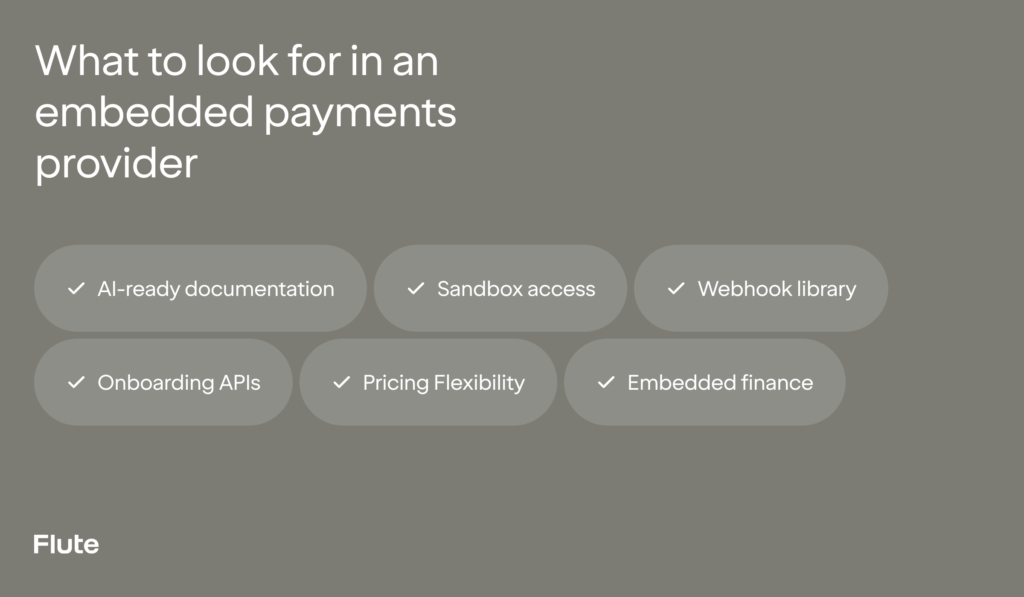
Not every provider is ready for this way of working. For instance, it’s crucial to have clean documentation written for humans and documentation an agent can parse and act on.
When you’re evaluating providers, look for:
The onboarding piece deserves special attention, because it’s where merchants feel the difference. If your platform already has most of the information a payments application needs (like a business user’s name, address, and contact details), a well-built onboarding API can pre-fill them, turning a 15-minute application into a 5-minute one. Nobody wants to type in their information three times to three different people, and your merchants shouldn’t have to.
Real-time webhooks are what turn a functional integration into a branded experience. When approval status flows back into your platform the moment it changes, a merchant can apply, get approved, connect a terminal, and see the confirmation — all inside your app, in your colors, and under your name.
The best payments provider stays invisible, so your platform gets the credit and builds brand loyalty.
Agentic development is democratizing embedded payments. When a non-developer can point an agent at a prompt and reach a working sandbox, the technical barrier disappears.
What can’t be automated is the hard-won knowledge of how payments actually work for a business — how to set go-to-market pricing, how to structure a payments program that grows platform revenue, and how to support merchants when something breaks at 6 p.m. on a Friday. As integration costs fall, the value of that insight rises.
Vertical software companies are winning merchants from traditional resellers because they ask better questions and solve deeper business problems. Today, payments are becoming a core part of that solution.
That’s why it’s important to evaluate providers on both levels: agentic capabilities and payment expertise.
The agent-ready integration gets you live fast. The people behind it — the ones who have launched hundreds of payment programs — are what turn payments from a feature into a business.
At Flute, we’ve built our platform for the future of development, with:
The technical part is fast. The partnership behind it is what our software partners stay for.
If you’re ready to add payments to your platform, talk to our team about what an agentic integration could look like for your product. Or visit our developer site here and click “Build with AI” to get started.