

Customer experience
Flexible payments
Read more
Building a checkout experience in-house means payment forms, compliance work, and endless upkeep. A hosted payment page hands all of it to your provider. Here's what it is, how it works, and when it's the right fit.
The most expensive page on a website is usually the one nobody wants to build: the payment form. It has one job, and it loses more sales than any other step. Baymard Institute puts the average cart abandonment rate at just over 70%, and 18% of U.S. online shoppers have abandoned an order because checkout was too long or complicated.
Software companies and businesses that build their own websites know the other side of that problem. “Add checkout” looks like a single line on the roadmap. In practice, it requires card field validation, error handling, mobile layouts, bank payment flows, industry compliance, and a security questionnaire nobody on the team has ever seen.
There’s a way to skip that build entirely and still give customers a smooth, secure way to pay. Let’s take a look at what a hosted payment page is, how it works behind the scenes, and why so many teams are handing checkout off to their provider.
A hosted payment page is a checkout page that lives on your payment provider’s servers instead of your own website. When a customer is ready to pay, your site or software redirects them to that page. The provider collects their card or bank details, processes the transaction, and sends the customer right back to your site. Your systems never touch payment data.
The concept goes by several names, like hosted checkout, redirect checkout, or hosted payment gateway. In short, the provider hosts, secures, maintains, and updates the page for as long as you use it, so your team can focus on growing the business.
Handing checkout to a provider changes more than who writes the code. The provider takes on the security, maintenance, and compliance work that comes with touching payment data, and your customers get a payment experience built by an experienced team.
Here’s what that looks like in practice:
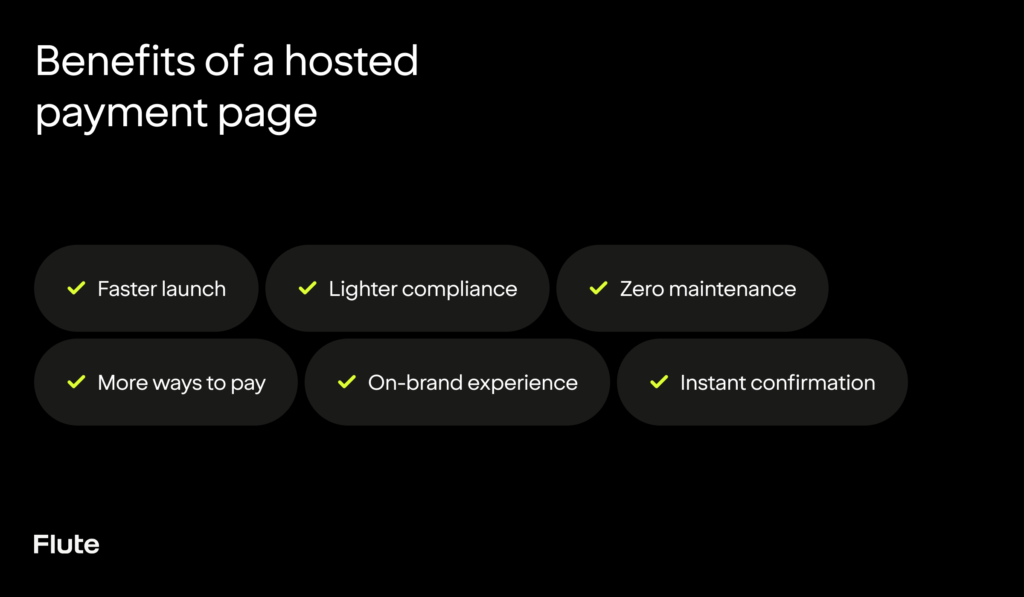
After integration, the model relies on what’s called a payment session. Here’s how it works, from click to confirmation:
That’s the whole integration: one API call out, one notification back. Everything between those two moments is the provider’s job.
There are three main reasons why businesses prefer to let their payment providers handle checkout: the challenges of building a checkout page in-house, meeting industry compliance, and maintaining customer trust.
A payment form is deceptively hard to get right. Card numbers need to be formatted and validated as the customer types; errors need clear recovery paths; the layout has to work on a five-year-old phone; and bank payments follow different rules than cards do.
The work never ends, either, because card networks and regulations keep changing. A hosted page eliminates the need to worry about any of that.
Any business that accepts card payments falls under the Payment Card Industry Data Security Standard (PCI DSS) and must meet a strict set of regulations. The burden scales with the volume of card data your systems handle, so the more you sell, the harder it is to stay compliant.
With a hosted page, customers enter card data directly on the provider’s servers, which means your systems never see it. That puts you at the lowest compliance level and turns what could be a months-long audit into a manageable project.
In a recent report on why shoppers abandon purchases, 19% said they didn’t trust the site with their credit card information. A hosted page helps because customers aren’t typing their card number into a small business’s website — they’re entering it on a page built and secured by a payments company, one that screens for fraud and is designed to protect card data. Customers can feel the difference, even when they can’t name it.
Hosted pages do ask for something in return: your customer briefly leaves your site to pay, and you don’t get to design every detail of the page they land on. Providers have closed most of that gap by letting you add your own logo and colors, so the handoff barely registers. Still, some large companies with large engineering teams choose to build their own checkout via a direct payment gateway integration, simply because they want to own every step themselves.
For most growing businesses, that trade is worthwhile. You give up a little design control and get back the months of building, the ongoing upkeep, and most of the compliance work that comes with handling card data.

A 2025 McKinsey merchant survey found that roughly 90% of U.S. merchants use an integrated software solution for payments or business management, up from 48% in 2022. If your customer is already on your website or in your app when it’s time to pay, a hosted page picks up right where they left off and completes the sale.
Say an independent contractor wraps up a week-long home renovation and the customer asks how to pay. Mailing an invoice means waiting a week or more, and it might get lost along the way. Texting a secure checkout link lets the customer pay on the spot, by card or bank transfer, before the truck leaves the driveway.
Contractors are just one example. The same handoff works across most industries:
Checkout is the moment your customer decides to trust you with their money, and it deserves more than a rushed build. A hosted payment page lets you meet customers in that digital moment with an online checkout that’s secure, accessible, and always up to date, without pulling your team off the product.
That’s exactly what we built our hosted checkout experience to accomplish. One API call creates a payment session and returns a hosted, branded checkout URL where customers pay by card or ACH on a mobile-ready page that meets Web Content Accessibility Guidelines (WCAG) standards.
Your existing pricing settings, like surcharging, cash discounting, and dual pricing, apply automatically. Partners typically go from first API call to live checkout in days.
If you’re ready to stop building payment forms and start taking payments, reach out to our team to see how a hosted checkout page would work for your business.