

Flexible payments
Mobile payments
Read more

Credit card sales usually take one to three business days to reach your bank account. Learn how settlement works and how instant payouts speed it up.
For most U.S. businesses, credit card sales take one to three business days to land in the bank. If you’ve ever wondered why it takes that long, or whether you really have to wait to access money you’ve already earned, the answer comes down to one process: settlement. Once you understand how settlement works, it’s much easier to plan your cash flow around it.
So, let’s take a look at what happens between the tap and the deposit, why the system moves at the pace it does, and what you can do when you need faster access to your earnings.
When a card is approved at checkout, that money has to go through a series of approvals before it can be transferred to you. Settlement is the process that moves money from your customer’s card-issuing bank to your business bank account.
First, the customer’s bank has to confirm the funds exist and set them aside. Timing varies by processor, industry, and batch schedule, but the standard window in the U.S. is one to three business days. Some processors offer next-day funding, while others hold funds longer for newer merchants or higher-risk industries.
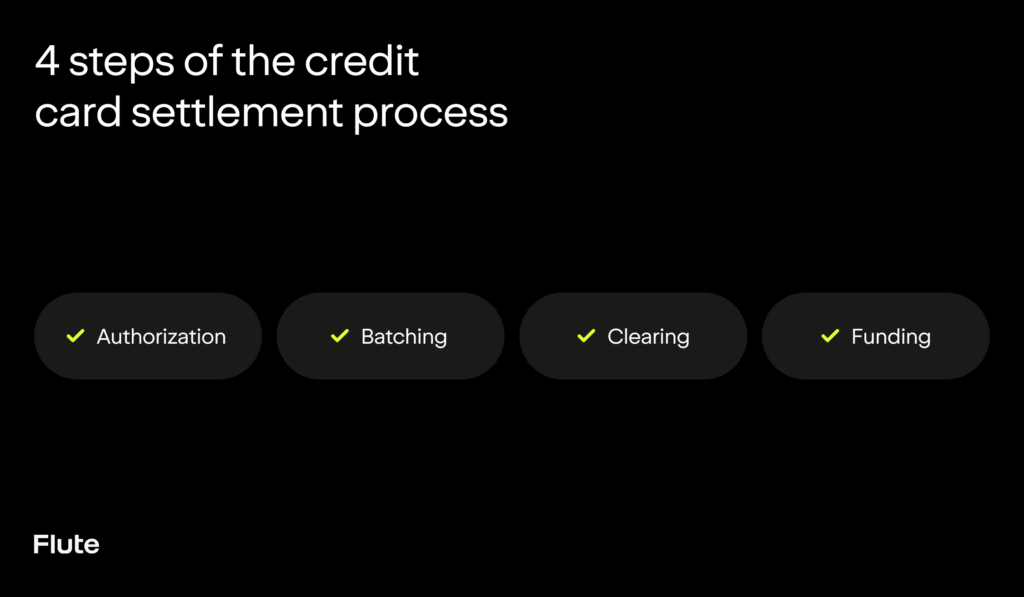
This process can be broken down into four key steps:
This is the moment of purchase. Your terminal or checkout page sends the card details to your payment processor, which routes them through the card network to the customer’s bank.
That bank confirms the funds are available and runs its fraud checks, then sends back an approval within a second or two. The funds are now earmarked for you — but they’re still sitting in the customer’s account.
Approved transactions collect throughout the day in a queue called a batch. At a set cutoff time, usually in the evening, your processor closes the batch and submits every sale at once. This is why timing matters; a sale that lands after the cutoff has to wait for the next day’s batch, which can add a full day to its journey.
Once the batch is submitted, the card network routes every transaction to the bank that issued each customer’s card. Those banks release the funds, calculate processing fees, and move the money to your processor’s bank. This step is where most of the waiting happens, since transfers run on systems that operate only on business days.
Finally, your processor deposits the settled funds into your business bank account. This is the only stage you actually see: the deposit that arrives one to three business days after the sale.
If a card can be approved in two seconds, why does the money take days to arrive? Because the settlement system was built to prioritize accuracy and security over speed.
There are a few forces at work during this process:
Each step is quick on its own. Stacked together, and paused every weekend, they add up to the familiar multi-day wait.
For a business with deep reserves, a two-day delay won’t make much of a difference. Most small- and medium-sized businesses don’t have that luxury.
One analysis of nearly 600,000 small businesses found that the median business has only 27 days of cash buffer, with restaurants having just 16. When your margin for error is measured in days, the gap between earning money and receiving it matters.
The speed of incoming payments matters, too. A 2025 report found that 60% of small businesses with longer payment terms experience cash flow problems, compared to 40% of businesses that get paid immediately. That means the faster money comes in, the fewer hard choices you have to make down the line.
Picture a caterer wrapping up the busiest weekend of the season. Although Saturday’s card sales were the best of the year, they need cash on hand Monday morning for their supplier. They also have to cover payroll on Tuesday. The revenue exists; the caterer earned it over the weekend, but those funds won’t reach their account until midweek — after bills and payroll are due.
That’s the settlement gap in real life: plenty of sales coming in, but a mismatch between when money is earned and when it arrives.
You can’t skip the settlement process, but you also don’t have to wait on it. Instant payouts let you move card revenue you’ve already earned into your bank account within minutes, on demand, any day of the week — including weekends and holidays. Instead of following the traditional banking timeline, the funds travel over real-time payment rails that operate around the clock.
Faster money movement is well underway across the economy. Recent Federal Reserve surveys found that 86% of businesses used faster or instant payments in 2023. Another report projects that real-time transactions worldwide will more than double to 575.1 billion by 2028, with North America among the fastest-growing regions.
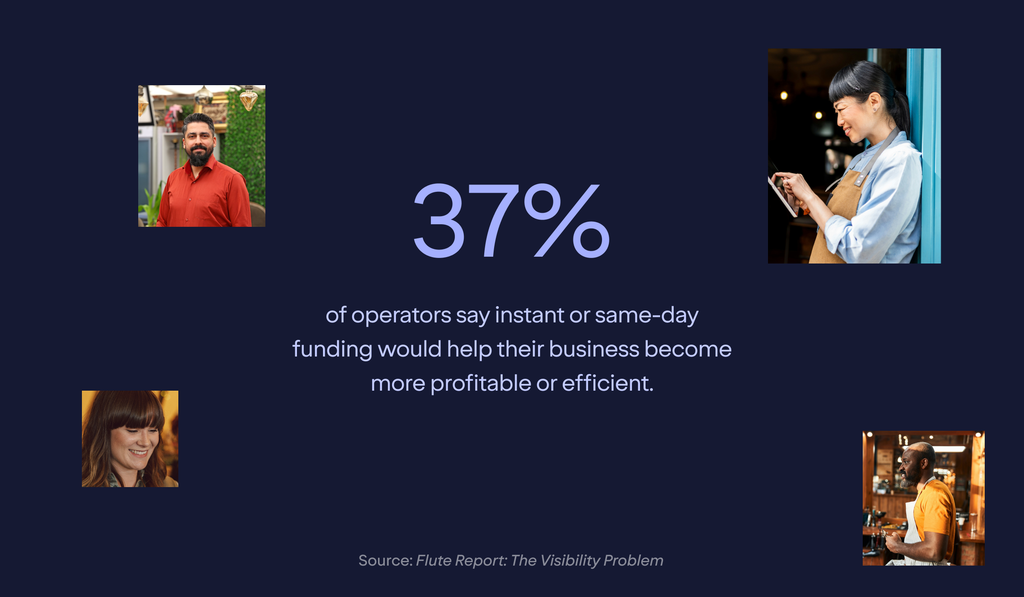
Growing businesses are desperate for faster access to revenue. One study found that 42% of small businesses would pay a fee to receive ad hoc payments instantly. And in our survey of 210 small-business operators, 37% said instant or same-day funding would help their business become more profitable or efficient.
Instant payouts usually carry a small per-transfer fee, around 1.75%, so many merchants stick to their usual settlement for everyday operations and reach for instant payouts when timing is tight, like a payroll run that can’t slip or a restock before a busy weekend. And because the money is revenue you’ve already earned, there’s nothing to apply for, no interest, and no debt on your books.
Settlement isn’t going away; it’s the backbone of card acceptance and makes the industry more secure and reliable. The difference is that business owners no longer have to wait for typical settlement times to access their earnings.
If you’re already a Flute customer, your first instant payout is a few clicks away. Sign in to your dashboard, open the Finance section, and request your payout. The funds arrive in minutes.
Not a Flute customer yet? Reach out to our team, and we’ll show you how instant payouts can work for your business.