

Fraud prevention
Understanding payments
Read more

A customer filed a chargeback — now what? Learn what chargebacks are, why they happen, and the six steps you can take to respond and win.
When a customer files a chargeback, a sale you thought was settled goes back into question. The funds come out of your account, a dispute fee gets added, and the burden of proof shifts to you. It happens more than it used to, too. Mastercard expects global chargeback volume to grow 37% by 2029, reaching 359 million disputes a year.
For a growing business, each incident costs revenue, fees, and hours of admin time.
The difference between merchants who bounce back and those who lose money to chargebacks usually comes down to having a plan. A chargeback is the start of a process with rules, deadlines, and a real chance to recover your revenue — if you know what to do.
Let’s look at what chargebacks actually are, why customers file them, and the six steps to take when one lands in your inbox.
A chargeback is a payment reversal initiated by the customer’s bank. Instead of asking you for a refund, the cardholder contacts the bank that issued their card and disputes the transaction. The bank typically gives the customer a provisional credit, pulls the funds from your account through your payment processor, and assigns the dispute a reason code that explains the claim. From there, you can accept the chargeback or challenge it with evidence.
That bank-first path is what separates a chargeback from a refund, and the difference shows up on your bottom line:
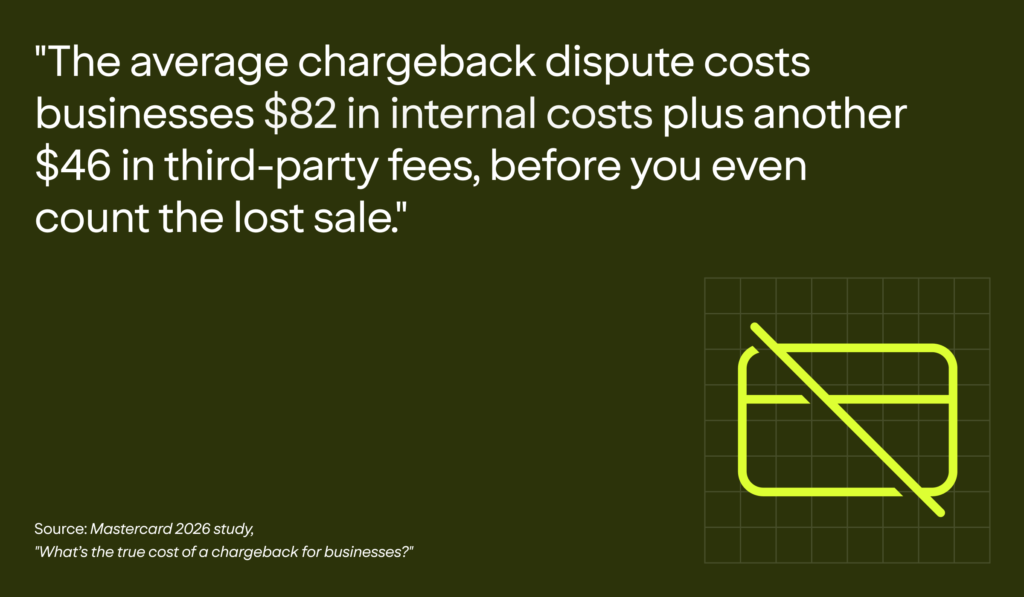
Research from Mastercard and Javelin puts the average dispute at $82 in internal costs plus another $46 in third-party fees, before you even count the lost sale.
Chargebacks exist for a good reason; they were created as a consumer protection, and they’re part of why customers feel safe paying by card at all. The trouble starts when that protection gets used in place of a simple refund request, which happens far more often than most business owners expect.
Nearly every chargeback falls into one of three buckets:
In Mastercard’s global survey research, merchants identified 45% of their chargebacks as fraudulent, a figure that includes friendly fraud alongside true fraud. However, friendly fraud is often a result of honest confusion, not bad intentions.
Mastercard found that 48% of consumers have mistakenly disputed a purchase that was actually legitimate, meaning the customer thought they had been impacted by fraud and requested a chargeback, when in reality, they just didn’t recognize the charge or remember buying anything.
Picture how easily that happens: A customer books a portrait session with a photography studio that processes payments under its parent company’s LLC. Two weeks later, a business name they’ve never heard of shows up on their statement. They don’t connect it to the photos on their wall, so they tap the dispute button. There was no bad intent anywhere in the chain, but the studio still lost the sale.
Sometimes, friendly fraud is more deliberate. A customer wants to skip the return process, regrets a purchase, or has learned that disputing feels easier than asking for a refund. Unfortunately, there’s no real way to tell what someone’s intentions are, which is why it’s so important to have documentation in case you need to dispute a chargeback.
When a dispute arrives, the clock is already ticking. In one report, consumers said they would go straight to their bank in 75% of disputes, so the notification from your processor is often the first you hear of a problem. Unfortunately, you have a limited window to react.
Here are six steps you can take to make the most of your time and have the highest chance of winning a chargeback dispute.
Every chargeback carries a reason code, a short designation from the card network that tells you what the cardholder is claiming: fraud, item not received, not as described, duplicate charge, and so on. The code determines which evidence will matter, so start there. Your processor’s dashboard will list it alongside the transaction details and the amount at stake.
Each card network sets its own chargeback time limit for merchants. Your processor may set a shorter one, often somewhere between 20 and 45 days from the notification. Miss the window, and you lose by default, no matter how strong your case is. Find the exact date, write it down, and work backward from it.
Not every chargeback is worth contesting. If the customer has a point, say the order shipped late or the charge really was duplicated, accepting the dispute is the honest move and saves everyone time. If the charge is legitimate and your records can prove it, fight it.

Compelling evidence is the documentation that directly contradicts the cardholder’s claim. Imagine an online boutique owner facing an “item not received” dispute. She looks over all of her documentation and finds what she needs to dispute the issue, including the order confirmation, the carrier’s delivery scan at the customer’s address, and the thank-you email the customer sent three days after the package landed.
Depending on the reason code, strong evidence includes:
Your chargeback rebuttal letter, sometimes called a representment or dispute response, should be short and specific. State the reason code, summarize the transaction, then walk through each piece of evidence and what it proves. Reviewers at the bank handle a lot of disputes, and a one-page response with clearly labeled evidence will beat a pile of unorganized attachments. Submit everything through your processor before the deadline, then confirm it was received.
Win or lose, every chargeback tells you something. Log the reason code, the outcome, and the product or service involved. For instance, look for billing descriptors that lead to “unrecognized charge” disputes, or product pages that result in “not as described” claims. If you see the same reason again and again, that’s a good indication that something needs to change.
Keep an eye on your overall chargeback ratio as well, because card networks penalize merchants whose ratio climbs too high, regardless of who wins the individual cases.
The most affordable chargeback is the one that never gets filed. One study found that every $1 lost to fraud now costs about $5.13 for U.S. retail and e-commerce businesses. It’s easy for the operational, compliance, and reputational costs of managing fraud to add up, which is a strong argument for prevention over cleanup.
Here are a few best practices to follow:
Chargeback prevention deserves a full playbook of its own, but these basics can help you meaningfully lower your dispute count in the meantime.
A chargeback doesn’t have to be a fire drill. Understand what the dispute claims, respect the deadline, respond with evidence that speaks directly to the reason code, and track what each case teaches you. Thankfully, the right payments partner will make every step easier.
At Flute, fraud protection and dispute support are built directly into our payments platform. That means you have access to clear dispute notifications, transaction records, and support from day one — all at no extra cost.
If disputes are eating into your margins, reach out to our team to learn how our chargeback support can help you save time and money.